Showing posts with label click chemistry. Show all posts

Monday, September 8, 2014

Making patterns with click chemistry

1.      Group of Fox used Tetrazine-trans-cyclooctene reaction for creating diffusion controlled 3D patterns (put it simply: particles) that could be filled with cells. Not a surprise cells stayed viable. The particles after all were made of hyaluronic acid derivatized with bioorthogonal chemistry that potentially can’t cause a harm. This work can find it’s future application in cell and tissue printing.
2.      Conceptually similar to the previous work, researchers in the group of Bart Jan Ravoo printed set of chemical functionalities using inverse-electron demand Diels-Alder chemistry (iEDDA) on the glass surfaces. In order to create those they employed a microcontact chemistry which enables to create large area patterns with high resolution. Essentially, you apply an ink that contain chemicals that you want to print on the surface on the PDMS stamps of defined geometry. 
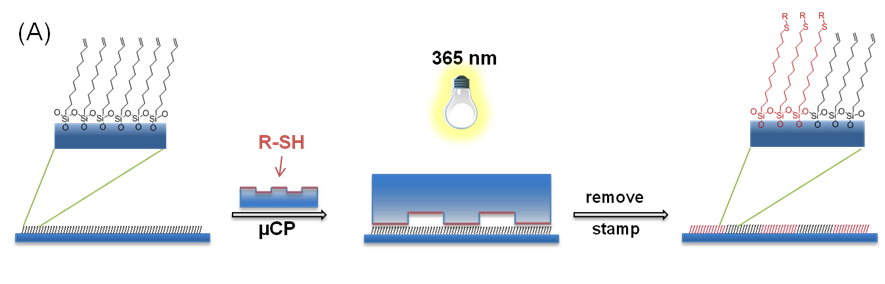
Next, you apply the stamp on the functionalised glass. The chemical coupling will occur only at the sites where groups are close to each other. Very cool and straightforward. I believe that this sort of chemistry will find its further development in the field of biosensors and microfluidics as long as they fix a few limitations of this technique. This are the low reproducibility of the PDMS stamp-patterning (due to its elasticity) and a necessity to use apolar inks which is again due to the high hydrophobicity of the PDMS.
3.      A biomolecule patterning is also a passion of Dr.  Hongyan Sun whi published her work in Chemical Communication son the immobilization of peptides and proteins on surfaces with use of the iEDDA. A protein microarray technology may benefit from from this work.

Tuesday, January 28, 2014

Dual color labelling in cell via SPIEDAC

Just read a fresh paper from Edward Lemke group in EMBL in last issue of Angewandte Chemie. They have 'adjusted' the SPIEDAC (Strain promoted Inverse Electron Demand Diels–Alder cycloaddition) such that now thay can efficiently dual label proteins in cell that bear byclononyne (BCN) and transcyclocotyne with a mixture of tetrazine and methyl-derivative of tetrazine containing dyes.

 It was well known that methyl-derivatized tetrazines are more stable and less reactive. I did not expect though that it will be so much less reactive so it will not be coupling with transcyclooctyne (see the picture). Great job!

Sunday, December 22, 2013

Building chemical nanoreactors out of proteins

Hi there! Today's short post is about usage of proteins as a generic scaffolds for designing chemical reactors.

Many good chemistries can not be simply accomplished in the tube because in order to proceed these reactions require very special conditions, such as presence of a metal in a certain oxidized state, or whole reaction should be shielded from the water solution since very unstable intermediate complex is formed during the reaction path. Thus having a nanoreactors with controllable conditions is a target of many chemists nowadays. There were numerous attempts to build such things out of complex organic molecules, however every single one needs a special approach and therefore lot's of effort. In contrast, mother nature successfully solved this problem (and keeps solving it) with proteins - the most generic chemical reactor. The reactions centers of many enzymes provide special conditions such as high hydrophobicity (lack of water molecules), or positioning of these water molecules in a reaction-favorable places. Upon finishing the reactions, active site of a protein will be freed from the product due to the special its characteristics. Thus some of the enzymes are able to perform reaction up to million times per second (turnover rate for carboanhydrase is half a million!) - much faster than chemistry in homogeneous environment would allow.

This time a group from University of Basel under the leadership of Professor Nico Bruns used a  protein that normally helps other proteins to fold (chaperonin) as a nanoreactor for polymerization. These sort of proteins form hydrophobic pores that are large enough to let macromolecules enter and leave it. Thus authors conjectured that this would be a perfect scaffold for assisting polymerization reaction. They simply modified chaperonin mutant cysteine residue with EDTA-like compound what let the catalytic Copper ion to be trapped inside the cavity, whereas monomers were allowed to enter the pore by diffusion. As a result they were able to obtain polymer with very low polydispercity index. 

Another example, probably less successful (that's why it is in 'Chembiochem', not in the 'Angewandte chemie' where previous paper appeared) but still interesting. Group of chemists under the supervison of developed by Prof. Peter G. Schultz). Then they coupled a number of BCN-linked organic ligands to the protein via Strain Promoted Azyde-Alkyne Cycloadition (SPAAC). Ligands in turn could form a complex with metals such as Rhodium, Manganese and Copper. Although authors could not reach anticipated velocities of some of the reactions they still were able to demonstrate the possibility to build such artificial metallo-enzymes. May be use of other protein scaffolds (such as mentioned above chaperonin) with  computational design aid (or probably directed evolution) could help us to get very active enzymes for biotech and pharma industry in future.

Wednesday, November 27, 2013

An elegant example of how tetrazine ligation can be used in treating desease

The So called Strain-Promoted Inverse Electron-demand Diels-Alder Cycloaddition or SPIEDAC is happen to be the most efficient way to couple molecules in the the chemically complex milieu of cells or biological fluids. This type of reaction that can be efficiently occurred in bioenvironment is called a 'click chemistry' and lately has been used in a number of synthetic biology tasks. 
This time, group of scientists from Eindhoven, Netherlands under the supervision of Marc S. Robillard from Phillips Healthcare elegantly exploited the fast reaction of Tetrazine/Trans-cyclooctene coupling to release the drug locally.
Many of the pharmaceutically active compounds have side effects and for sure many of them are toxic, but sometimes we have no choice and urged to use them. For instance, this happens when somebody is diagnosed with a cancer. Ideally, we want to bring the toxic compound to cancer cell while leaving the rest of the body unaffected. This could be done if something will bring the active chemical to the target where it will act. Quite often this vehicle is an antibody.
Essentially, this group coupled specific antibody to the transcyclooctene that in turn is covalently linked to the cancer treating drug (doxorubicine) via labile carbamate bond. So, the cancer cell-specific antibody will bring the drug to the surface of the cell. Next, we want to release it on place. For this reason we inject tetrazine to the bloodstream that will react with trans-cyclooctene breaking the carbamate bond and releasing the drug locally. This work so far has been done in the tube, so we are looking forward to see on in vivo models. Good luck!